Everything is a rental
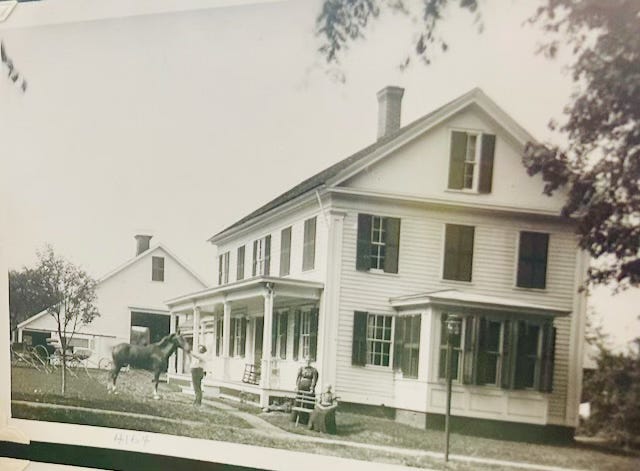
There is a very small room attached to the old livery barn where my studio in Massachusetts is located. A staged photograph taken by the Howes Brothers around 1900 shows my farmhouse and its occupants: a done-up middle-aged woman holding the back of a bench where someone’s irritated elderly mother reigns, posed on the pocket lawn. (I love these pride-of-place photographs the brothers took of the occupants of our village houses.)
To the side, and a little behind them, the owner of the livery barn stands between the house and his stable. Its main doors are open wide on both sides so a carriage—like the one he has pulled out for display—can pass through. The photograph proves to me that the pop-up I write in is an addition. He is holding a freshly curry-combed horse by its halter and looks proud of everything.
Now his barn is my art studio, and whoever added this box with a window looking out onto what was once a paddock gave me a contiguous place to work. I hung curtains between the office and the studio space for privacy and because, truthfully, when I come in through the wide glass doors cut into the original opening, the two sides of my brain are in a cage fight to see who gets to emerge first.
If the artist wins, she carries her coffee, sits in the rocker she brought up from Soho, and takes in what she’s working on across the big white wall—a meditation. If the writer wins, the coffee remains a companion, the curtains are drawn across the little office, the current manuscript is opened to the last completed page, and I crawl inside that village.
Two sides of the same brain battle for control. The writer usually wins and gets to go first, this being the more challenging genre. These words, lined up like battalions, must follow a set of grammatical rules I somehow missed that year in public school. Then, after so much revision—I am shocked by how many times I have to read and reread pieces—these new recruits fail to live up to my ambitious expectations and are filed into a virtual drawer where, like a good painting, elves rework the awkward bits. When I pull them out of purgatory, they are better than I remembered.
My paintings have storage racks in another bay of the barn—you can see the track-hung door in the photograph. They are stalled there between the racks, brought out when I have what Rilke called “the right eyes.” Works on paper sleep inside flat files and perform the same trick as the prose.
I use my method of cut and paste and work on top of older paintings, slice through fragments of writing. “Did you paint over that?” art dealers ask, disapprovingly, but I think the process keeps me honest. “Did you rewrite that chapter?” is accepted without question.
Time, and a commitment to it, is another difference. I can ask you over to look at a painting, and while sitting with your mug of coffee, your eyes sweep around the images, relate—or not—to the color and texture, and devise their own meanings. If you read my book, however, you are surrendering a generous allotment of time: time to draw your own images around my armature, time to reach your own gently maneuvered conclusions.
This barn belonged to the man with the freshly groomed horse. Then it belonged to whoever enclosed the paddock and added the little office. For now, it belongs to me.
Everything is a rental
.