That Girl

THAT GIRL
Two pictures look, to me, to be both sides of young me.
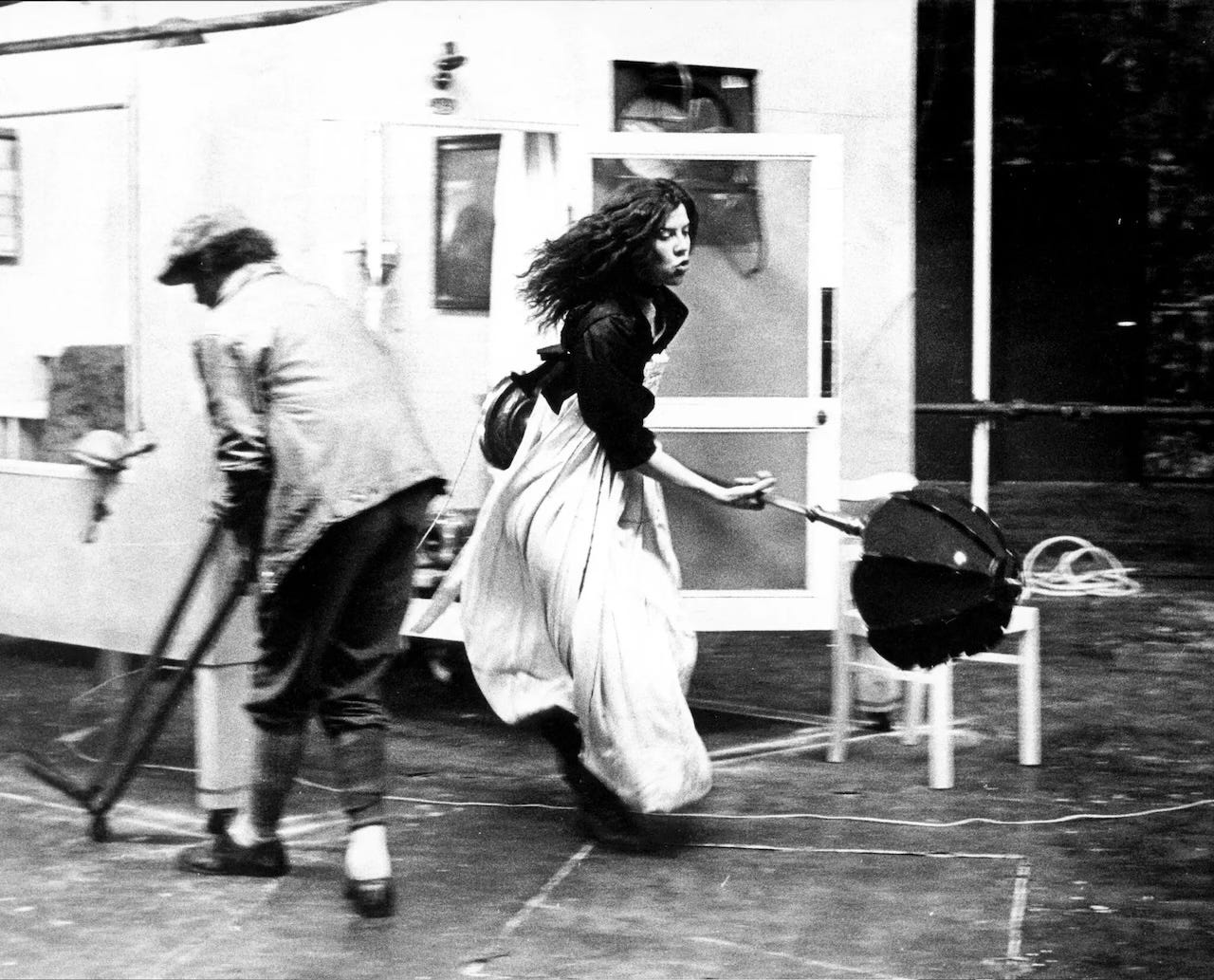
A wind of movement fills the thick skirt—tan or white in the black and white, and so many grays of the photograph accompanying the article—fluted with folds, hemmed to hold its bell-bottom shape beneath that black, full-sleeved shirt, that very favorite shirt she stuffed into the suitcase for New York first, now worn for the mostly improvised show The Wooster Group has christened Point Judith.
She’s in there, inside the garage façade on Wooster Street. The caption says 1979, so I’m there too.
I’m walking around Wooster Street but not going in. I’m outside, strutting, parading, using the interesting looks I’d grown into because I left Richmond, Virginia, with almost nothing. I didn’t use mascara or rub solid tan foundation around my face—my face now pulled into cheekbone caverns where only dimpled cheeks would have been if I’d stayed in Richmond, Virginia, in the land of mayonnaise.
I’m living in a basement loft two blocks from this portrayal of a young man’s mother’s madness. The young woman playing her uses her hair—like mine, thick, always called a mane, the natural curl finally free to tangle me into other people’s stories—and she uses that mane to go up and down and up and down and up and up and—down. The dark video evidence shows her standing, dropping her head, then her hair, then her head up again, again and again, and the gray matter of the foggy evidence shows a malignant madness being born. Or spreading.
I was three years out from being the art student in another, antique photograph of a young girl, my doppelgänger captured looking mistrustful around her talent, behind the sculpted legs of a three-quarter-scale clay model of a male figure carved to look exactly like all the others on the table—exactly the same. What will be her—my—fate with this skill?
Her sculpture faces away from her face, the sack that holds the model’s genitals squeezed into a shaped bag held up by a string. The two other exact copies have sculpted that same string around his waist so his buttock muscles can be better defined in clay. She’s embarrassed by how it felt to sculpt beneath that triangle of linen; she’s embarrassed about shaping the tender mounds, eyes poised on him—the model—and he felt it too, telling his penis not to stiffen, stopping the blood.
Art school is over; I’m out of that lab. Soho is happening, and I’m out and into the street with that magic power of availability I’ll never have again. I walk at night because I can, past the Wooster Street garage door swelling with downtown people inside, all inhaling the metallic taste of promise. The girl playing the playwright’s mother bends her head down, throws her mane behind it, pulls her head up all covered with hair, and then drops it down again with a violence her son thinks he remembers, as if her frustration is something he has a right to. The reenactor onstage makes this move sixty more times as I take the same number of steps to reach West Broadway—the safer street—searching for the painter who will turn my madness into his private memory.
*Libby Howes
This is elusive, intense, familiar and it makes me want a know that young artist