The Long Leash
A note on Philip Guston

Now here’s Philip Guston’s backstory, as it was told to us Parsons School of Design students, as urban myth: a WPA painter, he worked in that super-Americana figurative mural style, the kind of everyman painting being done—arguably better—by prominent Mexican muralists like Diego Rivera and José Clemente Orozco. So Guston had his academic chops.
When Abstract Expressionism broke out, heavy smokers like Philip Guston—probably the heaviest smoker among the macho row of male painters holding up the bar at the Cedar Tavern—supposedly watched Jackson Pollock swing his stubby arm into the face of Willem de Kooning, throwing the Dutch painter flat onto the sawdust-covered floor on University Place, just two blocks from the gaggle of studios on Fourth Avenue and 10th Street where they would stagger back to work.
By then the WPA was pretty much over, leaving space for Abstract Expressionism, the new American art—our country’s painters finally taking the crown away from those dusty Parisians working in Montmartre. But here’s an interesting plot twist, while the beat poets and towering critics bowed at the altar of the New York School of Painters, first and second wave, none of them knew that the Central Intelligence Agency was quietly using American art as a weapon in the Cold War, fostering and promoting Abstract Expressionist painting for more than two decades—roughly the 1950s and ’60s.
These big gestural, paintings were being used in the propaganda war with the Soviet Union—proof of the creativity, intellectual freedom, and cultural power of the United States compared to Russian art, strapped into the communist ideological straitjacket, both stylized and rigid (not too unlike the WPA murals you can still find in post offices and municipal buildings across the Midwest). This undercover project was unknown to the painters promoted under what later came to be called the “long leash” policy of the anarchic avant-garde moment.
Later it became clear that this freedom was not entirely freestanding. The artists were not instructed what to paint; they were amplified. Freedom was exported as proof of American intellectual liberty.
The gesture floated—but it did not float alone.
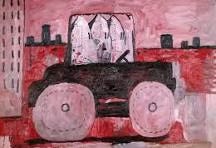
Philip Guston participated in that myth, switching from portraits of heroic farm workers to feathery brushstrokes, often in pink. Then he broke it. In 1970 he returned to figuration—hooded Klansmen, a smoking head, everything painted as childlike cartoon characters—collapsing the hierarchy that placed abstraction above image. His colleagues and critics recoiled. Younger artists saw something else: a refusal of transcendence. Painting came back down into history. The supposed center of painterly freedom faltered.